

The RBA’s fourth rate hike aims to get ahead of inflation expectations
By Grant Feng, Ph.D, Senior Economist, Asia-Pacific
Markets and economy
The Reserve Bank of Australia (RBA) raised the cash rate by 25 basis points to 4.6% at the monetary policy meeting today, delivering a fourth increase in what has become a distinctly front-loaded tightening cycle.
The decision reflects persistent inflationary pressures, compounded by uncertainty in the Middle East, which has pushed oil prices higher and intensified supply-side cost pressures.
With the economy continuing to operate close to, or potentially above, its sustainable capacity, as indicated by a tight labour market and a positive output gap, the RBA is signalling a clear determination to move monetary policy further into restrictive territory. Its immediate priorities are to restrain demand, prevent inflation expectations from drifting higher, and return inflation sustainably to target.
Elevated inflation remains the RBA’s overriding concern
Despite falling housing prices, trimmed-mean inflation remained elevated at 3.6% YoY in Q2, well above the RBA’s target range from its earlier forecast. Higher oil prices leave near-term inflation risks clearly skewed to the upside, while AI-related data centre investment is adding a further source of demand and capacity pressure. More fundamentally, the Australian economy continues to operate beyond its sustainable capacity, with unemployment remaining low by historical standards. Against this backdrop, there is a material risk that above-target inflation becomes embedded in wage- and price-setting behaviour. Preventing such an outcome is arguably a more pressing challenge for the RBA than for many other major central banks.
Headline and underlying inflation remain well above the RBA’s target range
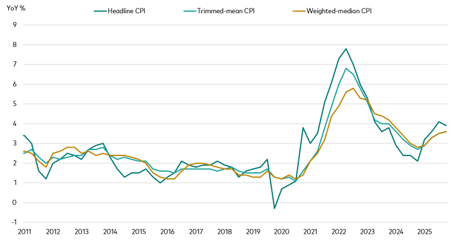
Source: Australian Bureau of Statistics, Vanguard. As at end June 2026.
Weak productivity remains the economy’s key supply-side constraint
Although real GDP growth remained resilient at 2.1% YoY in Q2, labour productivity declined by 0.2%. This suggests that Australia’s potential growth rate may have weakened, contributing to an acceleration in unit labour cost growth to 3.5%, from 3.3% in the first quarter. The combination of a tight labour market and subdued productivity growth is sustaining domestic cost pressures. As a result, the economy’s disinflationary impulse does not yet appear strong enough to return inflation to the RBA’s target within an acceptable timeframe.
Weak productivity keeps unit labour cost elevated
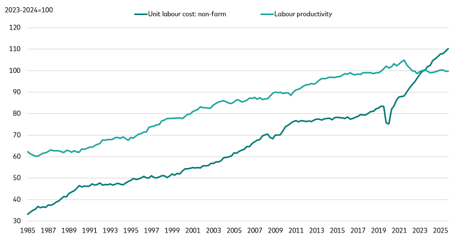
Source: Australian Bureau of Statistics, Vanguard. As at end June 2026.
The RBA’s reaction function appears to be shifting
Having historically lagged the global interest-rate cycle, the RBA now appears to be adopting a more pre-emptive approach. Four rate increases suggest that the Bank is increasingly willing to act before a clear deterioration emerges in the activity data, rather than waiting for inflation pressures to become more deeply entrenched. Although measures of household and business sentiment have weakened, the RBA remains firmly focused on its price-stability mandate. Its priority is clear: to prevent inflation expectations from becoming unanchored and to avoid repeating the experience of 2022, when inflation substantially exceeded expectations.
Further tightening will depend on realised demand, labour market conditions, and inflation
Higher interest rates and rising fuel costs have already contributed to a sharp deterioration in sentiment, raising the risk that a broader economic downturn is beginning to take shape. Sentiment indicators alone, however, are unlikely to dissuade the Bank from tightening again if underlying inflation remains elevated and realised activity proves resilient. The RBA will need to see clearer evidence that weaker confidence is translating into softer consumption, slower employment growth, greater labour market slack, and a sustained moderation in domestic inflation. Our base case is that the RBA pauses for the remainder of the year as it assesses the effects of the rate hike. This outlook is contingent on clearer evidence that demand is slowing, labour market conditions are easing and underlying inflation is moving sustainably lower. If the economy proves more resilient than expected, or if higher energy prices generate broader and more persistent inflationary pressure, the risk of an additional rate increase will remain firmly on the table.
Important Information:
This article contains certain ‘forward looking’ statements. Forward looking statements, opinions and estimates provided in this article are based on assumptions and contingencies which are subject to change without notice, as are statements about market and industry trends, which are based on interpretations of current market conditions. Forward-looking statements including projections, indications or guidance on future earnings or financial position and estimates are provided as a general guide only and should not be relied upon as an indication or guarantee of future performance. There can be no assurance that actual outcomes will not differ materially from these statements. To the full extent permitted by law, Vanguard Investments Australia Ltd (ABN 72 072 881 086 AFSL 227263) and its directors, officers, employees, advisers, agents and intermediaries disclaim any obligation or undertaking to release any updates or revisions to the information to reflect any change in expectations or assumptions.