

Most active fund managers struggle to beat the market
By Vanguard
Investing strategy
Looking at the 2025 results, active fund managers have continued to underperform when evaluated against lower cost ETFs
The 2025 SPIVA (S&P Indices Versus Active) Australia scorecard, which rates the performance of active managers, has just been released. The message is clear, beating the market is hard and staying ahead is even harder.
SPIVA measures the performance of actively managed funds relative to benchmarks over various time horizons, encompassing equity, real estate and bond funds.
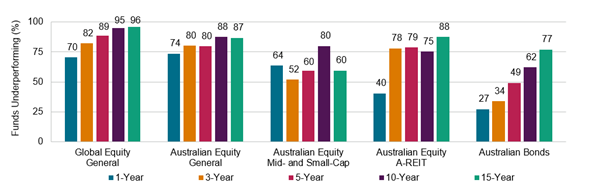
Exhibit 1: Percentage of Underperforming Active Australia Funds
End of year highlights
While some active fund managers had short-term success, most struggled to beat their benchmark over longer periods. The SPIVA Scorecard shows the majority of active equity managers underperformed across 2025.
- Global Equity General Funds: While active funds held up reasonably well in the first half of 2025, many fell behind later in the year. By year‑end, around 70% underperformed their benchmark. On average, these funds returned 9.6%, compared with a 13.3% gain from the S&P World Index (AUD). Over longer periods, the results were even weaker, with more than 95% underperforming over 10 and 15 years.
- Australian Equity General Funds: The S&P/ASX 200 Index rose 10.3% in 2025, marking its third consecutive year of double-digit growth, while actively managed Australian Equity General funds returned 7.5% on an asset-weighted basis. The underperformance rate was 74%, compared with its long-term average of 60%. Over 15 years, 87% of funds failed to beat the benchmark.
- Australian Equity Mid- and Small-Cap Funds: The S&P/ASX Mid-Small Index rose sharply in 2025, gaining 21.5%, which made it harder for active managers to keep up. Nearly two‑thirds (64%) of Australian mid‑ and small‑cap funds underperformed, with an average return of 13.2%. Over the long term, results have been modestly better than other categories, with around 60% underperforming over 15 years.
- Australian Equity A-REIT Funds: While the S&P/ASX 200 A-REIT category posted a healthy 9.2% gain, Australian Equity A-REIT funds delivered an asset-weighted average return of 11.7%, with 40% of funds underperforming, the lowest level since 2013. Over the 15-year period, however, 88% of funds underperformed.
- Australian Bonds Funds: Active bond funds’ relative performance improved in the second half of 2025 as credit spreads resumed tightening. The full-year underperformance rate was 27%, versus 46% in the first half of 2025, maintaining their recent history of relative better performance for the third year (2024 30% and 2023 26%). Active bond funds returned 4.0% on an asset-weighted average basis, compared with 3.2% for the S&P/ASX iBoxx Australian Fixed Interest 0+ Index in 2025.
Costs matter more than many investors realise
One of the biggest headwinds facing active managers is cost. Actively managed funds typically charge higher fees than index‑tracking funds. These costs may seem small in any single year, but over time they compound and can significantly reduce returns.
The SPIVA results highlight that, once fees are taken into account, many investors end up with returns below the market, despite taking on the risk of active management. Australian index investors enjoy a 0.90% fee advantage on average versus active managers, and this ‘cost hurdle’ means active managers must not only pick winning investments but do so consistently enough to overcome higher fees.
The scorecard also shows that not all markets are equally difficult. In certain less‑efficient segments, such as smaller companies or specific bond strategies, some active managers have had more success. But even in these areas, long‑term outperformance remains the exception rather than the rule.
For long‑term investors, the SPIVA Australia Scorecard offers an important reminder: investment outcomes are driven more by discipline, diversification and costs than by trying to pick winning managers.
Index‑tracking investments aim to capture the return of the market at a low cost, rather than trying to outperform it. Over time, this approach has helped many investors keep more of what markets deliver, without relying on the difficult task of identifying tomorrow’s top‑performing active fund.
Markets will always move through cycles, and active managers will continue to have periods of success. But the evidence suggests that a low‑cost, diversified approach remains one of the most reliable ways to build wealth over the long term.
Notes:
Past performance information is given for illustrative purposes only and should not be relied upon as, and is not, an indication of future performance.
Actual results could differ materially from those referred to in the above statements. In particular, distributions and capital growth are not guaranteed. Investments in managed funds and exchange-traded funds are subject to investment and other known and unknown risks, including possible delays in repayment and loss of income and principal invested. Please see the risks section of each product’s PDS for further details. Neither Vanguard Investments Australia Ltd (ABN 72 072 881 086 AFSL 227263) nor its related entities, directors or officers give any guarantee as to the success of managed funds and exchange-traded funds, amount or timing of distributions, capital growth or taxation consequences of investing in such funds.