

To hedge or not to hedge? How to manage foreign currency exposure
By Vanguard
Investing strategy
Explore the pros and cons of currency hedging
Australians are increasingly investing internationally, thanks to the wide range of exchange-traded funds (ETFs) and managed funds listed on the ASX.
Global diversification can help spread risks in your portfolio, and historical evidence and logic strongly support this approach.
But when you invest in overseas assets, you’re not just exposed to market ups and downs. Currency fluctuations can amplify or reduce your returns, sometimes dramatically.
For example, the Australian dollar has swung from above parity with the U.S. dollar in 2011-2013 to less than 70 cents today.
One way to manage this risk is through currency hedging. Hedged funds aim to reduce the impact of exchange rate movements, while unhedged funds leave you exposed to currency swings.
How does currency hedging work?
Currency hedging is a strategy used by fund managers to reduce the impact of foreign exchange fluctuations on portfolio values.
It typically involves using forward contracts to lock in exchange rates for future transactions. Think of it like converting your dollars before an overseas holiday to avoid the risk of a weaker AUD later.
Hedging acts as a form of insurance, but it comes at a cost. Hedged ETFs and funds often have slightly higher management fees and can result in higher taxable distributions.
The flipside is that hedged investors miss out on any upside if the Australian dollar falls. For example, long-term unhedged investors in U.S. assets have benefited from the Australian dollar’s depreciation since 2011, which has provided a boost to returns in AUD terms.
Vanguard offers both options. For example, the Vanguard MSCI Index International Shares ETF (VGS) is unhedged, while VGAD is its hedged counterpart.
Hedging is particularly important when investing in fixed income investments overseas.
It is generally accepted that to maintain international bonds’ defensive characteristics in a portfolio, they should be hedged, as their benefits would otherwise be overwhelmed by currency movements.
What is Vanguard’s outlook for the Australian dollar?
Recent Vanguard research suggests the Australian dollar is likely to remain broadly stable against major currencies over the next decade.
Our currency framework models a long-term equilibrium exchange rate based on real interest rates and productivity differences, adjusted for central bank policy stances. Currently, the AUD sits in the middle of its fair-value range, indicating balanced currency risks over the long term.
Risks are balanced for fairly-valued Australian dollar
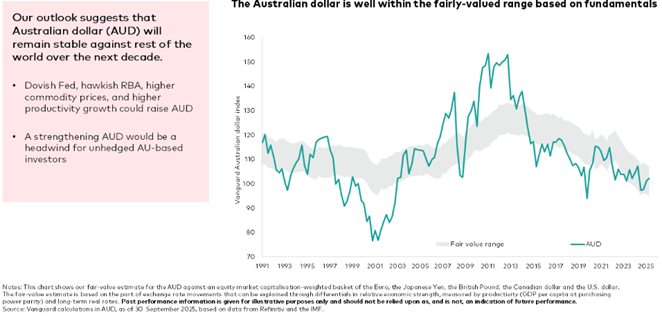
Importantly, currencies remain volatile in the short term, so deviations from long-term fair value can persist. This is why we don’t recommend using currency forecasts for short-term trading decisions.
For investors, a strengthening AUD would be a headwind for unhedged portfolios, reducing returns on international assets.
Conversely, a weaker AUD boosts unhedged returns and benefits Australian companies earning profits overseas.
Key takeaways
Hedging is about managing risk, not chasing returns.
While our outlook suggests the AUD may remain stable over the long term, short-term volatility is inevitable.
Hedging is not a one-size-fits-all decision. The choice should come after building a plan, setting an asset allocation and considering costs.
The decision doesn’t have to be all-or-nothing either. Many investors and their advisers aim for a “least regret” approach by hedging around 50% of the portfolio.