

RBA on hold, but retains a hawkish bias
By Grant Feng, Ph.D, Senior Economist, Asia-Pacific
Markets and economy
The Reserve Bank of Australia kept the cash rate unchanged at 4.35% at the monetary policy meeting on 11 August 2026, extending its pause following three consecutive rate hikes earlier this year.
Although inflation remains well above the target range, a modest rise in unemployment, slightly softer-than-expected trimmed-mean inflation, emerging headwinds in the housing market and the recent pullback in oil prices should reduce the immediate pressure on the RBA to tighten policy further.
Trimmed-mean inflation was only marginally below the RBA’s forecast, leaving the Bank with little scope to relax its inflation vigilance.
First, the near-term inflation outlook remains uncomfortable: both headline and underlying inflation are still well above target, while heightened uncertainty in the Middle East could place renewed upward pressure on energy prices. Second, household spending has been resilient, as consumption growth in June was stronger than expected. Consumption growth in June exceeded expectations, with households continuing to spend across a range of discretionary categories despite falling house prices. These developments suggest that monetary policy may not yet be sufficiently restrictive to return inflation credibly and sustainably to the target range. Even while keeping rates on hold, the RBA is therefore likely to retain a tightening bias until it sees clearer evidence that demand is slowing enough to alleviate underlying inflation pressures.
Inflation still remains elevated
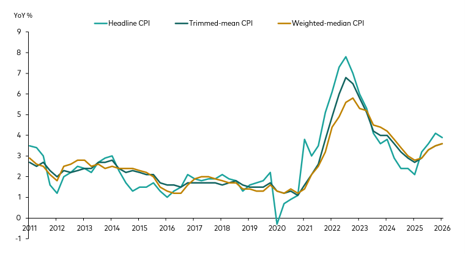
Notes: CPI from end June quarter 2011 to end June quarter 2026.
Source: Australian Bureau of Statistics, Vanguard
While inflation risks remain concerning, indicators of economic activity have softened.
Labour market conditions are gradually easing, with the unemployment rate rising to 4.4% in June. Broader measures of labour market slack, including underutilisation and underemployment, have also increased over recent months. Meanwhile, the housing market, a key channel through which monetary policy affects the Australian economy, is cooling. This partly reflects the cumulative impact of the RBA’s three rate increases, alongside significant tax changes announced in the May Federal Budget. We expect house prices to decline further over the coming quarters, generating a negative wealth effect that should weigh on household spending and, ultimately, inflation.
We have long argued that Australia’s growth and disinflation challenges are predominantly supply-side in nature, particularly given persistently weak productivity growth.
The inflation outlook ultimately depends on the balance between aggregate demand and aggregate supply. Sluggish productivity growth and limited supply-side momentum mean that apparently soft activity data do not necessarily imply that inflation pressures will subside quickly. Resilient household spending and elevated trimmed-mean inflation continue to suggest that policy may not yet be restrictive enough to return inflation sustainably to target.
Looking ahead, the combination of a lower starting point for inflation, a loosening labour market, slowing growth and falling house prices should allow the RBA to refrain from further rate increases for the remainder of the year.
RBA has tightened financial conditions materially over a relatively short period, and the full effects have yet to flow through the economy. Early evidence from the housing market nevertheless indicates that higher interest rates are already beginning to constrain domestic demand. Against this backdrop, still-elevated inflation argues against an early easing of policy, while weakening activity reduces the case for another immediate rate increase. In Vanguard’s view, this points to an extended period of restrictive policy rather than a further near-term adjustment. We continue to expect the RBA to remain on hold throughout this year, while retaining a hawkish bias. Any subsequent policy move is likely to be delayed until 2027.
Important Information:
This commentary contains certain ‘forward looking’ statements. Forward looking statements, opinions and estimates provided in this commentary are based on assumptions and contingencies which are subject to change without notice, as are statements about market and industry trends, which are based on interpretations of current market conditions. Forward-looking statements including projections, indications or guidance on future earnings or financial position and estimates are provided as a general guide only and should not be relied upon as an indication or guarantee of future performance. There can be no assurance that actual outcomes will not differ materially from these statements. To the full extent permitted by law, Vanguard Investments Australia Ltd (ABN 72 072 881 086 AFSL 227263) and its directors, officers, employees, advisers, agents and intermediaries disclaim any obligation or undertaking to release any updates or revisions to the information to reflect any change in expectations or assumptions.