

The three phases of retirement: Key decisions at every stage
By Vanguard
Super and retirement
Retirement starts long before your last day at work
There are certain moments in life that reshape not just your finances, but the way you live.
Starting a family, moving overseas for a job, changing careers – retirement belongs in that same category in terms of its significance.
Traditionally, retirement has been viewed as a single milestone celebrated on the day you stop working. But in reality, it’s one of the longest and most significant chapters of your life – one that’s being reshaped by longer life spans, evolving retirement rules and rising living costs.
With Australians now living longer than ever, retirement can span decades, bringing new priorities, changing spending habits and different financial decisions along the way.1
That means retirement isn’t simply something to prepare for. It’s something you’ll need to navigate through.
Know what you’re aiming for
Before thinking about how you’ll fund retirement, however, it’s worth asking a simpler question: What kind of retirement do you actually want?
The Association of Superannuation Funds of Australia (ASFA) Retirement Standard provides a useful benchmark by estimating the annual income needed to support different retirement lifestyles
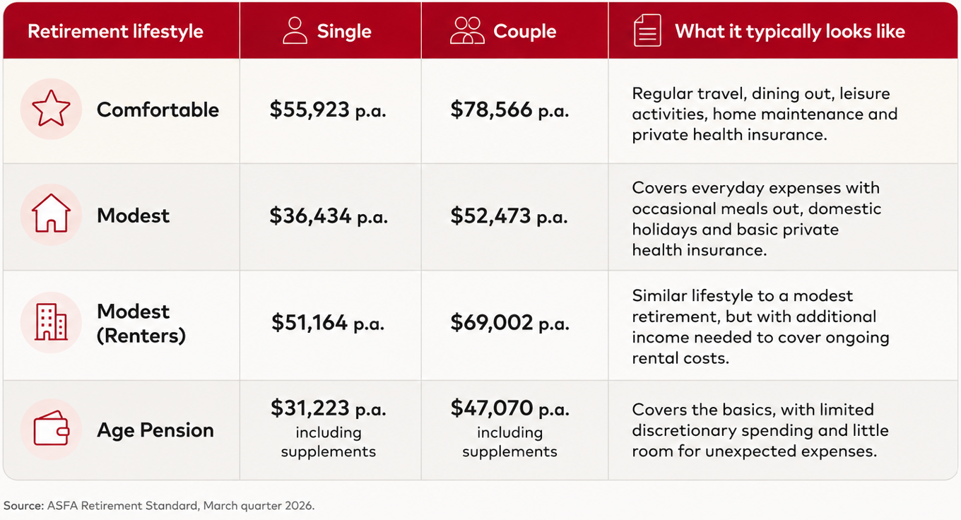
There’s no right or wrong answer. Some Australians dream of travelling the world, while others are happiest spending more time with family, pursuing hobbies or enjoying a slower pace of life closer to home.
The important thing is having a destination in mind. After all, it’s difficult to know whether you’re saving enough – or investing appropriately – if you don’t know what you’re trying to fund.
With that in mind, here are the three broad phases of retirement and the financial considerations that tend to become most important in each.
Phase 1: Building your retirement runway
The five to ten years before retirement are a critical time for financial planning.
This is when many of the biggest financial decisions get made – when to retire, what sort of lifestyle you want, whether you’re saving enough and how to make the most of your remaining working years.
Having a clear retirement plan can make a meaningful difference. Vanguard’s How Australia Retires 2026 report has shown Australians who understand the steps they need to take for retirement are significantly more confident about funding their desired lifestyle and more optimistic about their future than those without a plan.
It’s also the time to take stock of your financial position.
While seven-figure super balances often grab headlines, they’re far from the norm. Australians aged 60 to 64 have a median super balance of around $236,126 for men and $174,655 for women.2
With many Australians approaching retirement with relatively modest super balances, making the most of available opportunities to contribute to super and strengthen retirement savings can be particularly valuable.
Here are several key questions to ask in the decade leading up to retirement:
- How much do I currently have in super and other investments, and will it support the lifestyle I want in retirement?
- Are there any big-ticket experiences I want to budget for, such as a luxury cruise, overseas travel or helping my children financially?
- Will I be in a position to pay off my mortgage before retirement?
- Do I want to stop working completely, or gradually transition through part-time or consulting work?
- Would downsizing or relocating improve my retirement lifestyle or financial position?
Phase 2: Putting your nest egg to work
Once retirement begins, your financial mindset will likely shift.
Instead of building wealth, the priority becomes generating an income that can support your lifestyle while ensuring your savings last for what could be another 20 or 30 years.
For many people, this can be an uncomfortable transition. After spending decades trying to grow your retirement savings, you’re now relying on them to fund your lifestyle
Retirees also need to consider sequencing risk – the impact a market downturn can have if it occurs early in retirement while you’re simultaneously drawing an income from your portfolio.
As a result, some retirees choose to maintain exposure to growth assets alongside defensive investments and cash, depending on their circumstances, objectives and tolerance for risk.
While liquidity can help fund day-to-day spending and reduce the need to sell investments during volatile markets, growth remains important because inflation continues long after your working life ends.
Your retirement income may also come from multiple sources including investments held outside super and, depending on your circumstances, the Age Pension.
Here are several key questions to consider as you approach and enter retirement:
- Where will my retirement income come from – super, investments, rental income, the Age Pension or a combination of these?
- Is my investment portfolio still appropriate now that my focus has shifted from building wealth to drawing an income?
- Can my income keep pace with inflation?
- Do I have enough cash or liquidity to cover unexpected expenses or periods of market volatility?
- Am I reviewing my spending regularly to ensure my savings remain sustainable over the long term?
Phase 3: Planning your legacy
As retirement progresses, financial planning often becomes about much more than investment returns.
Many retirees begin thinking more carefully about how they’ll be cared for if their health changes, whether their current home still suits their needs and how they want their assets distributed to loved ones.
While these conversations aren’t always easy, planning ahead can provide greater flexibility, reduce stress for your family and ensure your wishes are understood well before important decisions need to be made.
At some stage during retirement, these are some of the conversations worth having:
- Is my will up to date, and have I reviewed my beneficiary nominations?
- Have I considered how I would fund aged care or additional healthcare needs if they arise?
- Does my current home still suit my needs, or would another living arrangement be more appropriate?
- Have I appointed the right people to make financial or medical decisions if I’m unable to do so?
- Does my estate plan reflect the legacy I want to leave for my family and loved ones?
Strategies to consider
Your retirement plan doesn’t need to be perfect. The important thing is to start early, review it regularly and adapt it as your circumstances change.
Here are some practical strategies to consider. As always, it’s important to consider whether any strategy is appropriate for your personal circumstances and seek professional advice if needed.
- Start small. Retirement planning doesn’t have to happen all at once. Start by discussing a few key questions with your partner or a financial adviser, such as when you’d like to retire and how much super you may need.
- Review your super regularly. Make a habit of logging into your super account and checking your balance, investment options, fund performance and insurance cover.
- Make the most of super contributions. If you’re still working, additional concessional (before-tax) contributions could help grow your retirement savings.
- Understand carry-forward contribution caps. If your total super balance is below $500,000 and you meet the eligibility requirements, you may be able to use unused concessional contribution caps from the previous five financial years.
- Learn about downsizer contributions. If you’re 55 or over and meet the eligibility requirements, selling your home may allow you to contribute up to $300,000 each (or $600,000 per couple) into super.
Make a start this September
This month, Vanguard is encouraging Australians to take small, practical steps towards their financial future through the Super September challenge.
Whether it’s logging into your super account, learning something new about retirement or beginning to map out a plan, September is a good time to take your first or next step towards a more confident retirement.
Take the Super September Challenge
- ASFA Retirement Standard Budgets for various households and living standards for those aged 65-84 (March quarter 2026)
- Median super balance, by age and sex, 2023–24 financial year – Australian Taxation Office