

Rotation away from large-cap tech accelerates
By Shaan Raithatha, Vanguard Senior Economist
Markets and economy
Why the AI winners are no longer just the Magnificent Seven
The “Magnificent Seven,” the large-cap tech companies that have been the darlings of the U.S. stock market for so long, underperformed in the first half of 2026. While the Standard & Poor’s 500 Index returned a healthy 9%, the Mag 7 fell 1%, with Microsoft and Meta being notable laggards. This underperformance intensified late in the period as the Mag 7 dropped almost 9% in June, its worst month in more than a year.
So what is going on? The dominant narrative is that investors are increasingly questioning whether the large investments committed by the AI “hyperscalers”—Alphabet, Amazon, Meta, Microsoft, and Oracle—will deliver sufficient returns amid elevated expectations and intensifying competition. This is something we flagged in the Vanguard Economic and Market Outlook for 2026.
But there is more going on behind the scenes. Rising costs for memory chips and electrical equipment are squeezing profit margins at large-cap tech companies. (Apple and Microsoft recently announced price increases for some popular products.) Two other factors also likely weighed on returns: Investors had heavy allocations to richly priced large-cap tech stocks, and the Federal Reserve pivoted to a hawkish stance, affecting growth stocks disproportionately.
Instead, investors are rotating away from large-cap tech and into companies that produce the physical components and infrastructure that are in high demand as hyperscalers ramp up their investment ambitions. These include suppliers of high-bandwidth memory (think SK Hynix and Micron) as well as providers of lithography machines (such as ASML), electrical infrastructure (such as Schneider Electric), and servers (such as Cisco and Dell).
In our midyear capital market outlook, we referred to this broader set of global companies as the “AI complex,” and highlighted material upward revisions to earnings expectations for this group in recent months. This AI complex, excluding hyperscalers, returned 100% in the first half of 2026, a significant outperformance relative to both the Mag 7 and broader S&P 500. We prefer this measure to the narrower (and price-weighted) Philadelphia Semiconductor Index, which is also shown in the figure for comparison.
The Magnificent Seven underperformed in the first half of 2026
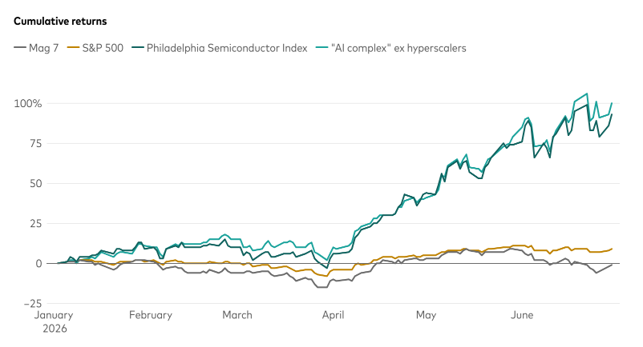
Notes: The Mag 7 consists of Alphabet, Amazon, Apple, Meta, Microsoft, Nvidia, and Tesla. The “AI complex” ex hyperscalers category refers to a group of roughly 45 companies globally that are driving the physically intensive buildout of AI infrastructure, including companies focused on semiconductors, high-bandwidth memory, data centres, networking, and energy infrastructure. This group excludes the hyperscalers Alphabet, Amazon, Meta, Microsoft, and Oracle. Past performance is not a guarantee of future results. The performance of an index is not an exact representation of any particular investment, as you cannot invest directly in an index.
Sources: Vanguard calculations, based on data from Bloomberg as of June 30, 2026.
We expect the AI complex to remain volatile, given the sharp recent run-up. In the week ended July 17, the Philadelphia Semiconductor Index and Asian technology stocks came under significant pressure amid concerns that the trade may have gotten ahead of itself, and on news of the launch of a Chinese AI model, called Moonshot, that could rival top U.S. systems.
Looking ahead, we remain constructive on the shorter-term outlook for equities as the AI investment cycle deepens. A decrease in oil prices from recent highs amid conflict in the Middle East should also be supportive for risk sentiment.
Our medium-term outlook is more cautious. The next phase of the AI story is more about whether current investment translates into productivity gains for the broader global economy. History tells us that over time, the benefits of general-purpose technologies spread throughout the economy from the sector that drove the initial innovation. This tendency, coupled with already stretched valuations in U.S. growth stocks, is why we continue to prefer U.S. value stocks and developed markets equities outside of the U.S. over longer time horizons.
Footnotes:
- Local currency price return, weighted by market capitalisation in U.S. dollars.
Notes:
All investing is subject to risk, including possible loss of principal.
Investments in stocks or bonds issued by non-U.S. companies are subject to risks including country/regional risk and currency risk. These risks are especially high in emerging markets.
This article contains certain ‘forward looking’ statements. Forward-looking statements, opinions and estimates provided in this article are based on assumptions and contingencies which are subject to change without notice, as are statements about market and industry trends, which are based on interpretations of current market conditions. Forward-looking statements including projections, indications or guidance on future earnings or financial position and estimates are provided as a general guide only and should not be relied upon as an indication or guarantee of future performance. There can be no assurance that actual outcomes will not differ materially from these statements. To the full extent permitted by law, Vanguard Investments Australia Ltd (ABN 72 072 881 086 AFSL 227263) and its directors, officers, employees, advisers, agents and intermediaries disclaim any obligation or undertaking to release any updates or revisions to the information to reflect any change in expectations or assumptions.