

The US still leads. But opportunity doesn’t end at its borders.
By Vanguard
Markets and economy
For much of the past decade, investors have been rewarded for a relatively simple strategy: maintain a significant allocation to US equities, particularly the largest technology companies
Superior earnings growth, technological innovation, deep capital markets and a resilient economy propelled US equities to outperform most developed and emerging markets by a considerable margin.
The question facing investors today is not whether these companies remain high-quality businesses. Rather, it is whether future market returns will be as concentrated as they have been over the past decade. Increasingly, there are signs that leadership is beginning to broaden across regions, sectors and investment styles.
Importantly, recognising opportunities outside the United States does not require investors to become bearish on America. The US remains home to many of the world’s most innovative and profitable businesses.
But for Australian investors who already have substantial exposure to US equities, looking beyond America may be less about reducing US exposure and more about improving diversification.
US success has created concentration risk
Several factors have underpinned US success, including leadership in technology and innovation, strong corporate profitability, highly developed capital markets and a concentration of world-leading businesses. These strengths remain intact today.
Strong fundamentals and high expectations are driving U.S. returns
Profit margins and revenue growth are rising
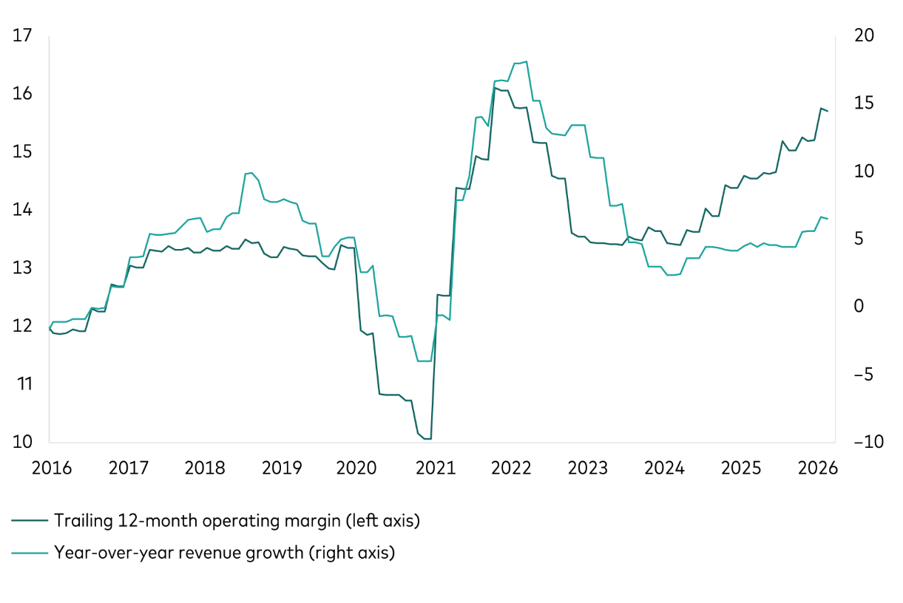
Notes: Operating margins and revenue growth for the S&P 500.
Past performance is no guarantee of future returns. The performance of an index is not an exact representation of any particular investment, as you cannot invest directly in an index.
Source: Vanguard calculations, based on data from Bloomberg, as of June 30, 2026.
However, history suggests that extraordinary performance often brings concentration. The ten largest companies now represent close to 40% of the S&P 500, while the Magnificent Seven alone account for roughly one-third of the index.
Concentration is not inherently bad. In recent years it has been a powerful tailwind, reflecting exceptional earnings growth from a relatively small group of companies. The challenge is that portfolio outcomes become increasingly dependent on fewer businesses continuing to meet very high expectations.
When a larger share of returns is driven by a smaller number of companies, investors become more exposed to valuation compression, earnings disappointments or shifts in market sentiment.
For many investors, the key issue is not whether the US remains an attractive market. It is whether portfolios have become more reliant on a single market and a narrow group of companies than intended.
Market leadership is beginning to broaden
Several developments suggest investors may be entering a different phase of the market cycle. International equities outperformed US equities during 2025, reversing a trend that had persisted through much of the previous decade.
Improved growth expectations, lower relative valuations and a weaker US dollar all contributed to stronger performance outside the United States.
At the same time, investor flows have increasingly moved toward Europe, Asia and emerging markets as investors search for diversification and valuation opportunities. Many international markets continue to trade at meaningful discounts to US equities despite improving earnings prospects.
Emerging markets equities led the way
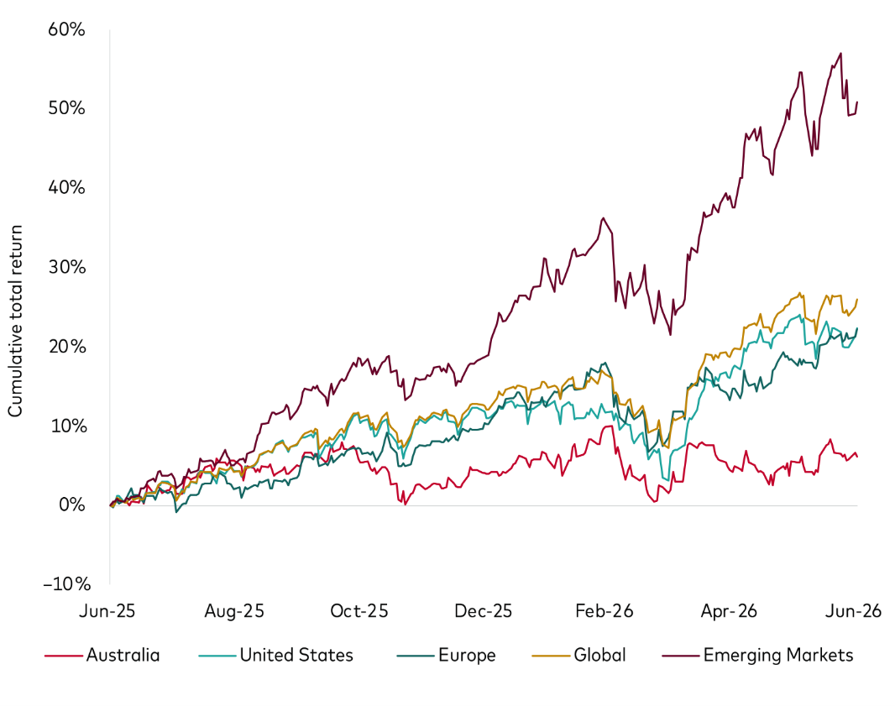
Notes: Cumulative gross total return in local currency for the following indices: ASX 300 Index, S&P 500 Index, MSCI Europe Index, MSCI All-Country Index, and the MSCI Emerging Markets Index.
Past performance is no guarantee of future returns. The performance of an index is not an exact representation of any particular investment, as you cannot invest directly in an index.
Source: Vanguard calculations based on data from Bloomberg as of 30 June 2026.
Earnings growth is also becoming less dependent on a narrow group of mega-cap technology companies. While AI-related spending remains a powerful driver of profitability, a broader range of companies and sectors are now contributing to overall earnings growth than was the case several years ago.
None of these developments signal the end of US leadership. Rather, they suggest future returns may become less concentrated and more broadly distributed across markets.
Why ex-US exposure isn’t a bet against America
One of the most common misconceptions about investing outside the United States is that it requires a negative view on the US economy or US companies.
In reality, the opposite may be true.
Many of the companies benefiting from global growth and technological innovation are located outside the United States. Consider the infrastructure underpinning artificial intelligence. While much of the attention has focused on US technology giants, the physical foundations of the AI ecosystem are highly global.
Semiconductor manufacturers, chip equipment providers, memory suppliers, industrial automation firms and specialist technology companies across Asia and Europe all play important roles in enabling AI adoption.
This is an important distinction. The growth of AI is not purely a US software story. It is also a global supply-chain story. Some of the beneficiaries of continued US-led innovation may be found outside America.
The same logic applies to the next phase of AI development. Vanguard has argued that while the first phase of the AI cycle has rewarded infrastructure providers and technology leaders, future gains may increasingly accrue to companies that use AI to improve productivity, reduce costs and enhance profitability. Those companies could emerge across a wide range of industries, sectors and geographies.
For Australian investors, this perspective is particularly relevant because many portfolios already have substantial exposure to US equities. Broad global equity funds, market-cap weighted indices and diversified portfolios have naturally increased their US allocations as the market has outperformed. As a result, many investors now carry significant exposure to both the US market and growth-oriented mega-cap technology stocks.
Adding exposure to international markets outside the United States is therefore not necessarily a bet against America. In many cases, it can simply be a way to reduce concentration risk, broaden sources of return and gain exposure to regions and sectors that may benefit from the same economic and technological trends driving growth in the US.
What it means for portfolios
The end of US exceptionalism is not a forecast. The US remains home to many of the world’s most innovative and profitable businesses, and its long-term investment case remains compelling.
However, there is growing evidence that market leadership is becoming broader, valuations outside the US remain attractive relative to history, and investors are increasingly reassessing concentration risks within portfolios.
For advisers and investors, this is less about reducing US exposure and more about ensuring portfolios are resilient across a wider range of future outcomes. If US exceptionalism continues, globally diversified portfolios are still likely to participate in that success. But if leadership broadens, opportunities may increasingly emerge beyond the largest US technology companies.
Different ways to access opportunities beyond the US
Investors who share this view have several options. For those seeking broad exposure to developed and emerging markets outside the United States, the Vanguard All-World ex-US Shares Index ETF (VEU) provides diversified access to thousands of companies across international markets.
Investors looking for a more targeted approach may consider the Vanguard Global Value Equity Active ETF (VVLU), which seeks attractively valued companies around the world. As market leadership broadens and earnings growth becomes less concentrated, value-oriented companies and sectors may be well positioned to benefit from a wider distribution of market returns.
The question for investors is not whether to bet against the US. It is whether portfolios are overly reliant on a single market and a small group of companies to drive future returns. Some of the biggest beneficiaries of future US-led growth, innovation and AI adoption may be found outside the United States. As market leadership broadens, diversification may matter more than it has for many years.
Important information:
“Bloomberg®” is a service mark of Bloomberg Finance L.P. and its affiliates, including Bloomberg Index Services Limited (“BISL”), the administrator of the index (collectively, “Bloomberg”) and have been licensed for use for certain purposes by Vanguard. Bloomberg is not affiliated with Vanguard, and Bloomberg does not approve, endorse, review, or recommend Vanguard products. Bloomberg does not guarantee the timeliness, accurateness, or completeness of any data or information relating to Vanguard Products. © 2026 Bloomberg. Used with Permission.
The index is a product of S&P Dow Jones Indices LLC (“SPDJI”), and has been licensed for use by Vanguard. Standard & Poor’s® and S&P® are registered trademarks of Standard & Poor’s Financial Services LLC (“S&P”); Dow Jones® is a registered trademark of Dow Jones Trademark Holdings LLC (“Dow Jones”); S&P® and S&P 500® are trademarks of S&P; and these trademarks have been licensed for use by SPDJI and sublicensed for certain purposes by Vanguard. Vanguard product(s) are not sponsored, endorsed, sold or promoted by SPDJI, Dow Jones, S&P, their respective affiliates and none of such parties make any representation regarding the advisability of investing in such product(s) nor do they have any liability for any errors, omissions, or interruptions of the index.
The funds or securities referred to herein are not sponsored, endorsed, or promoted by MSCI, and MSCI bears no liability with respect to any such funds or securities. The PDS contains a more detailed description of the limited relationship MSCI has with Vanguard and any related funds.
This article contains certain ‘forward looking’ statements. Forward looking statements, opinions and estimates provided in this article are based on assumptions and contingencies which are subject to change without notice, as are statements about market and industry trends, which are based on interpretations of current market conditions. Forward-looking statements including projections, indications or guidance on future earnings or financial position and estimates are provided as a general guide only and should not be relied upon as an indication or guarantee of future performance. There can be no assurance that actual outcomes will not differ materially from these statements. To the full extent permitted by law, Vanguard Investments Australia Ltd (ABN 72 072 881 086 AFSL 227263) and its directors, officers, employees, advisers, agents and intermediaries disclaim any obligation or undertaking to release any updates or revisions to the information to reflect any change in expectations or assumptions.
Past performance information is given for illustrative purposes only and should not be relied upon as, and is not, an indication of future performance. In preparing the information, individual circumstances, for example tax implications, have not been taken into account and it may, therefore, not be applicable to an individual’s situation. Before making an investment decision, you should consider your circumstances and whether the above information is applicable to your situation.
Vanguard Investments Australia Ltd (ABN 72 072 881 086 / AFS Licence 227263) (“Vanguard”) is the issuer of the Vanguard® Australian ETFs.
Vanguard ETFs will only be issued to Authorised Participants. That is, persons who have entered into an Authorised Participant Agreement with Vanguard (“Eligible Investors”). Retail investors can transact in Vanguard ETFs through Vanguard Personal Investor, a stockbroker or financial adviser on the secondary market.