

Why the AI playbook may have fewer technology stocks
By Vanguard
Markets and economy
The AI megatrend is likely to trigger a stocks rotation over the medium term
Most of us have heard of the so-called “Magnificent Seven” U.S. technology stocks – Apple, Microsoft, Amazon, Alphabet (Google), NVIDIA, Meta Platforms, and Tesla.
Collectively, because of their huge investments in developing different AI (artificial intelligence) technologies, they have been the engines driving most of the strong growth on the United States’ and global share markets over recent years.
Yet, according to Vanguard’s Global Chief Economist Dr. Joe Davis, the evolution of the AI megatrend is likely to trigger a “great rotation” over the medium term where the strongest performers on stock markets won’t necessarily be the developers of the AI technologies but the companies that are using AI technologies to maximum effect.
Opportunities for investors
“Our research and forecasts have uncovered some exciting, ‘contrarian’, investment opportunities perhaps not widely known for the next five to seven years,” Dr. Davis told attendees at the Vanguard Adviser Roadshow 2026 last week.
“Because of our high conviction based on this research, we’ve already reallocated certain ETF (exchange traded fund) model portfolios. They’re central to our 2026 Vanguard economic and market outlook.”
He said the biggest insight from Vanguard’s deep research is that while the Magnificent Seven stocks have been the best investments over the first half of the AI period of technological change, they are expected to underperform other stocks over the second half.
“The more bullish you are on AI, the less tech/growth stocks [will be] in your portfolio,” Dr. Davis said, drawing a parallel to past megatrends such as the rollouts of railroad networks and the inventions of electricity, motor cars, and personal computers.
The developers of the technologies behind these megatrends achieved very strong returns over the short term. But it was companies that later leveraged these technologies, forming totally new industries, that achieved more sustainable returns over the long term.
Dr. Davis said the three main reasons why this happened in every past megatrend period are likely to be repeated as AI continues to evolve.
Reason 1: Broader adoption vs valuation.
As AI becomes a general-purpose technology and adoption spreads, the higher returns on equity (ROE) will move from AI producers to AI users/consumers such as financial institutions, healthcare companies, education providers, and others.
Reason 2: New competition.
Similar to the evolution of the car industry in the 20th Century, which saw thousands of start-ups and a high failure rate, Dr. Davis said the AI sector is likely to follow a similar path. He said new “tech stars” will emerge, but as an asset class overinvestment and high failure rates are likely to see the technology sector underperform.
Reason 3: Creative disruption.
Dr. Davis said that general purpose technology providers are disrupting their own industry the most, which is already evident in the U.S. in particular as new AI technologies challenge the dominance of software companies.
The outlook for markets outside of the U.S.
While the U.S. and China are significantly ahead of the rest of the world in the AI race, Dr. Davis said other economies, especially those with low automation rates and large service sectors, such as Japan, Europe, Australia and Canada, could also see significant benefits.
AI and tech innovation remain geographically concentrated
Top 5 corporate R&D spenders by sector and country/region
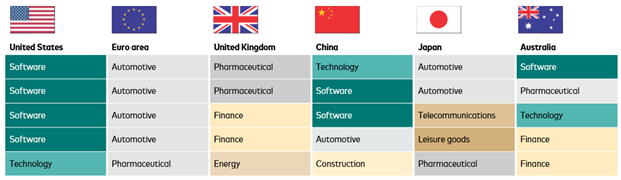
Notes: This table is based on the 2025 EU Industrial R&D Investment Scoreboard, which analysed the world’s top 2,000 research and development (R&D) investors, headquartered across 40 countries. The table depicts the top five corporate R&D spenders by sector within six countries/regions, allocated geographically by the location of company headquarters.
Sources: Vanguard calculations, based on data from the European Commission, as of December 31, 2025.
“AI investment could see AI payoffs through automation plus adoption, even if they are not strong AI creators,” he said, describing this as good convergence where “U.S. stock market exceptionalism ends because other markets catch up, not because AI is a bubble,” Dr. Davis said.
In this recent video, Dr. Davis explains how AI investment is likely to accelerate and transform the global economy.
Important information
This article contains certain ‘forward looking’ statements. Forward-looking statements, opinions and estimates provided in this article are based on assumptions and contingencies which are subject to change without notice, as are statements about market and industry trends, which are based on interpretations of current market conditions. Forward-looking statements including projections, indications or guidance on future earnings or financial position and estimates are provided as a general guide only and should not be relied upon as an indication or guarantee of future performance. There can be no assurance that actual outcomes will not differ materially from these statements. To the full extent permitted by law, Vanguard Investments Australia Ltd (ABN 72 072 881 086 AFSL 227263) and its directors, officers, employees, advisers, agents and intermediaries disclaim any obligation or undertaking to release any updates or revisions to the information to reflect any change in expectations or assumptions.